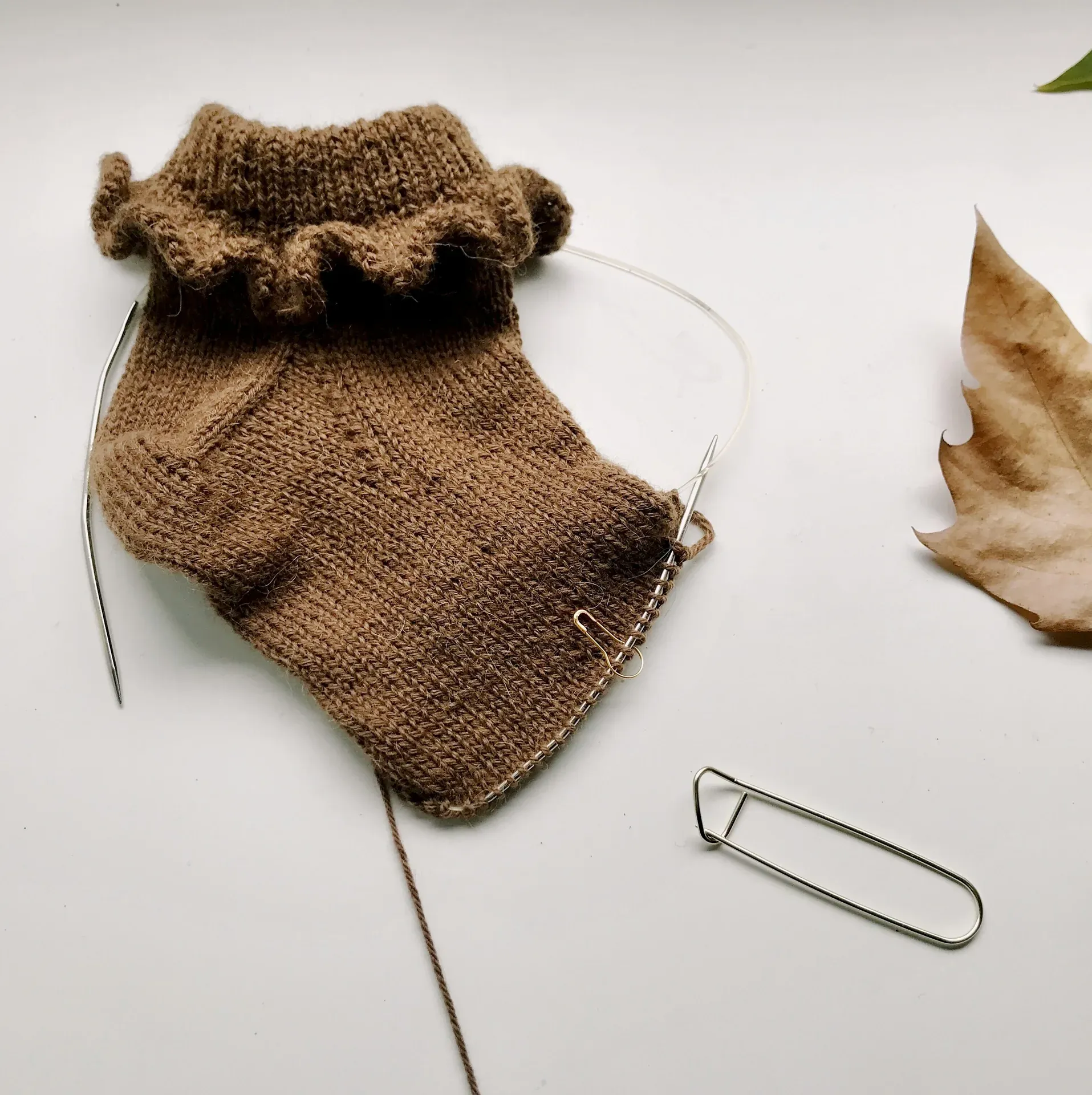
M1L and M1R: mirrored increases explained
M1L and M1R are nearly invisible mirrored increases made from the bar between stitches. Learn both step by step, and how to avoid the hole that ruins them.
 By Sofia AkramiKnyt Co-founder and editor
M1L (make one left) and M1R (make one right) are mirrored increases made by lifting the horizontal bar between two stitches onto the needle and knitting into it. M1L leans left, M1R leans right, and worked correctly they're nearly invisible. They're the standard paired increases for sleeve shaping, raglans, thumb gussets and shawls, and the most error-prone move on this site, because knitting into the wrong leg of the lifted bar leaves a hole.
The idea behind both
Between the stitch you just worked and the next one lies a horizontal strand: the bar. Both increases lift that bar onto the left needle and knit it. The direction you lift it, and which leg you knit into, decide the lean. Knitting into the awkward leg is what twists the strand closed so no hole forms.
M1L (leans left)
- With the left needle, lift the bar between the stitches from front to back, so it sits on the needle.
- Knit it through the back loop, the leg behind the needle.
It will feel tight. That's how you know you're in the right leg: if it's easy to knit into, you're probably in the wrong one.
M1R (leans right)
- Lift the bar from back to front onto the left needle.
- Knit it through the front loop.
Memory aid: "I'll be right back": M1R is picked up from the back. M1L is the opposite: picked up from the front.
Where to place them
The classic placement is M1R before a marker, M1L after it, so the increases lean away from the marker symmetrically, the standard look on raglan lines and gusset shaping. Because the bar only exists between stitches, work them at least one stitch in from the row edge.
Common mistakes
- A hole where the increase was: the number one failure. You knitted into the easy leg, which leaves the strand untwisted (essentially a yarn over). The correct leg always feels tight.
- Swapped leans: lifting from the wrong direction reverses the lean. Check against the memory aid.
- A rock-tight new stitch: work at the needle tips; the bar has very little slack to give.
- Expecting the increase line to point the way its name says: the name describes the individual stitch's lean; a stacked column of M1Ls can read as a right-slanting line. Trust the pattern's placement.
M1 vs kfb
Both add one stitch. M1 is nearly invisible but slightly fiddly; kfb is easier but leaves a visible bump, and it consumes a stitch (worked into an existing stitch, not between stitches), so the two aren't interchangeable without adjusting placement counts.
Frequently asked questions
What is the difference between M1L and M1R?
Both lift the bar between stitches. M1L lifts it front to back and knits through the back loop, leaning left; M1R lifts it back to front and knits through the front loop, leaning right.
Why is there a hole where I made my increase?
You knitted into the wrong leg of the lifted bar, leaving it untwisted. The correct leg is the tight, awkward one; twist is what closes the hole.
Which do I use if the pattern just says M1?
Either works if no lean is specified; many knitters default to M1L. In mirrored shaping, follow the pattern's L/R exactly.
Is M1 the same as kfb?
No. Both increase by one, but M1 is made from the bar between stitches and is nearly invisible; kfb is worked into an existing stitch and leaves a small visible bar.
Vad heter M1L och M1R i svenska mönster?
Många svenska mönster använder förkortningarna som de är; helsvenska beskrivningar skriver ofta "öka 1 vänsterlutande/högerlutande" eller beskriver upplyftet i klartext. Tekniken är densamma.
Co-founder and editor of Knyt. Avid knitter!